Monday, May 14, 2007

Real Life Issues with respect to Performance Management

I was just relaxing a little bit from another long day at the client site when I saw this movie on YouTube. In my opinion the movie really shows the bottlenecks within an organization with respect to performance management.

Enjoy!

Wednesday, May 09, 2007

SAP Extends Leadership in Delivering Solutions to the CFO with Acquisition of OutlookSoft Corporation

I just saw this press release. Things are changing in the CPM market. First was the takeover of Hyperion by Oracle and now the takeover of OutlookSoft by SAP.

The press release can also be found at http://www.outlooksoft.com/news_events/press_releases/2007/sap.htm

Walldorf, Germany and Stamford, CT—May 8, 2007
Extending its leadership in delivering complete solutions for the CFO, SAP AG (NYSE: SAP) today announced its intention to acquire OutlookSoft Corporation, a privately held provider of integrated planning, budgeting, forecasting and consolidation software. Today’s announcement marks another milestone in SAP’s multi-year plan to holistically address the increasingly sophisticated requirements of the CFO around driving business performance, managing risk, ensuring compliance and spearheading financial transformation in their organizations. In making the announcement, SAP stated that the acquisition is expected to be completed in June 2007, pending approval from the respective antitrust authorities. Terms of the acquisition were not disclosed.


CFOs today face increasing pressure to meet regulatory requirements and drive efficiencies while at the same time playing a strategic role in driving the growth and profitability of the business. SAP’s build/partner approach, supplemented by strategic “fill in” acquisitions, has enabled CFOs to benefit from the most comprehensive, integrated set of financial business processes. Building upon the market-leading, cross-industry financial applications suite within SAP ERP, CFOs can ensure business compliance and manage risk with integrated governance, risk and compliance management applications (SAP solutions for GRC) and improve their business performance linking strategy to execution with risk-adjusted planning and corporate performance management (SAP solutions for performance management). The transaction with OutlookSoft is continuing evidence of SAP’s strategy to use well-placed acquisitions to complement its broad solution offering by gaining innovative technologies, while maintaining its successful organic growth track record.


“Across industry segments and global markets, CFOs are under tremendous pressure to improve business performance, predictability and stakeholder confidence,” said Doug Merritt, corporate officer and member of the Executive Council, head of Business User Development, SAP AG. “Leading companies are looking to establish unified, easy-to-use best practice business processes that enable a predictive and risk-adjusted approach to performance. OutlookSoft completes another key component of our multi-year strategy to build, partner and acquire unique offerings for CFOs, a strategy based on thorough market analysis and customer input. OutlookSoft brings the people, intellectual property and expertise that will enhance the SAP business user experience and add value for a strong cross-section of our customer base.”
OutlookSoft InnovationRecognizing customers’ needs for an innovative new approach to performance management, OutlookSoft was founded in 1999 to deliver the standard for next-generation solutions based on unprecedented ease-of-use for the business user and unified experience across all performance management processes. OutlookSoft focused on this vision by modernizing solutions for the CFO leveraging Web 2.0 technologies to enable collaboration across the enterprise and delivering real-time, predictive analytics capabilities and finance-ready business process flows, an extensible library of procedures guiding business users through all performance management activities and facilitating collaboration.The company’s vision has been validated by more than 700 customers globally, a record year in 2006 with 25 percent revenue growth and an unprecedented win-rate against its competitors with the latest availability of OutlookSoft 5. OutlookSoft’s singular commitment to the CFO, its deep domain knowledge and its vision for next-generation performance management solutions clearly complements SAP’s core expertise in integrated financial applications and strengthens the company’s strategy to effectively address the increasingly complex requirements of the finance organization.


OutlookSoft’s modern, standards-based solution is built on a service-oriented architecture (SOA), thus enabling customers to take advantage of OutlookSoft 5 and extend the value of their SAP solutions by leveraging integration with SAP’s service-enabled applications via a common technology platform, SAP NetWeaver. In particular, SAP NetWeaver Business Intelligence (SAP NetWeaver BI), with over 14,000 installations, will provide the robust BI infrastructure powering the OutlookSoft 5 application and deliver a common user experience to the business user.“From the beginning, OutlookSoft has focused on helping business users, the executive team and, most importantly, the CFO,” said Phil Wilmington, president and CEO, OutlookSoft. “Our solution unifies organizations, disparate systems and processes through innovative technology and accessibility to information. This is an exciting time for our customers and partners, as we combine the business process expertise and technology platform from SAP with the usability and deep functionality of OutlookSoft’s performance management application.”


About OutlookSoft Headquartered in Stamford, Connecticut, OutlookSoft employs approximately 250 people and has offices in the United States, United Kingdom, France, Switzerland and Italy. For additional recent news about SAP’s solutions for the CFO, please visit: http://www.sap.com/company/press/press.epx?pressid=7596.

About SAPSAP is the world’s leading provider of business software*. Today, more than 39,400 customers in more than 120 countries run SAP® applications—from distinct solutions addressing the needs of small businesses and midsize companies to suite offerings for global organizations. Powered by the SAP NetWeaver® platform to drive innovation and enable business change, SAP software helps enterprises of all sizes around the world improve customer relationships, enhance partner collaboration and create efficiencies across their supply chains and business operations. SAP solution portfolios support the unique business processes of more than 25 industries, including high tech, retail, financial services, healthcare and the public sector. With subsidiaries in more than 50 countries, the company is listed on several exchanges, including the Frankfurt stock exchange and NYSE under the symbol “SAP.” (Additional information at http://www.sap.com).

Friday, May 04, 2007

Underpinnings of Integrated Performance Management - Part III

Integration: “Talking the same language”

Performance management is all about the successful execution of strategy. We identify four guiding principles to translate strategic directives into an effective performance management cycle. In part I and II we discussed focus and alignment. In this post we want to discuss the third principle which is integration: talking the same language.


Integration is about three main ideas:

  • Interlinking planning, measuring and intervention processes
  • Comprehensive information strategy and supporting technology architecture
  • Incentives and rewards for people embedded in the performance management system

To link performance management processes, the first step is to define and describe these processes. This is relatively straight-forward to do. For each process and sub-process, define inputs and outputs, interdependencies among processes and process steps. For each process and process step, responsibility should be assigned to individual employees. To achieve linkage, the planning and reporting process needs to be integrated with people performance management and goal setting in terms of timeline, process steps and content.

The next step in integration is developing the right technology infrastructure. Technology needs to be supportive to the value model, management control structure and processes defined earlier (see part I and II).

To provide a solid foundation, the first step here is to define the enterprise information model based on information requirements to support key decisions across all major business dimensions. The enterprise information model is used to identify and implement an IPM specific toolset (this can be an ERP or best-of-breed solution). IPM tools and requirements need to be integrated into the overall IT strategy & architecture.

The most challenging part in integration is establishing rewards and incentives supportive of the performance management system. It requires establishing a framework for rewarding performance, and ensuring that the framework for rewards and incentives is linked to the planning, measuring and intervention processess.

This starts with establishing a common understanding of "performance" including functional differences and providing a framework to define individual performance expectations to individual employees. Furthermore, managers need to be provided the tools and processes enabling them to appraise performance according to individual performance expectations. Finally, reward must be linked to both achievement of corporate strategic goals and individual performance.

In the last post in this serie we will elaborate on the last remaining guiding principle for successful strategy execution: behaviour.

Friday, April 13, 2007

Underpinnings of Integrated Performance Management - Part II

Alignment: “All pulling in the same direction”

Performance management is all about the successful execution of strategy. We identify four guiding principles to translate strategic directives into an effective performance management cycle. In part I we discussed focus. In this post we want to discuss the second principle which is alignment: all pulling in the same direction.

Alignment is about three main ideas:

1. Cascading targets throughout the organization
2. Clear management control and accountability
3. Project portfolio and initiatives linked to value drivers

To communicate targets, processes must be established for aligning and cascading performance measures. This is typically a combination of both a top-down as well as a bottom-up approach.

A consistent breakdown must be defined and communicated of corporate targets, initiatives and performance measures to subunits- and individual targets, initiatives and performance measures. Targets should be aligned across business dimensions (e.g. function, geography, customer) to facilitate joint value creation and co-operation.

To establish clear management control and accountability, the first step is to define organisational accountability.

Responsibility must then be assigned to business units, functions etc. for each target, initiative and performance measure. Based on this a clear management control and reporting framework can be established. Finally, employee performance targets and objectives are defined and aligned with strategic objectives and value drivers.

Linking projects and initiatives to value drivers is an essential step in achieving alignment.

All projects and initiatives are categorised and prioritised by contribution to strategic objectives. This requires establishing a clear linkage to overall value drivers. Based on the contribution to strategic objectives of current projects, new initiatives might need to be developed.

In future posts we will elaborate on the remaining guiding principles for successful strategy execution: integration and behaviour.

Friday, April 06, 2007

Underpinnings of Integrated Performance Management - Part I

Focus: "Only Doing What Matters"

Performance management is all about the successful execution of strategy. We identify four guiding principles to translate strategic directives into an effective performance management cycle. The first is focus: only doing what matters.

Focus is about three main ideas:

  1. Shared understanding of value creation across the organization
  2. Identified key value drivers linked to strategic directive
  3. Planning, execution and measurement of what matters

To come to a shared understanding of value you will first need a high-level model of how value is being created in your company. This model needs to breakdown into value drivers and improvement levers. Each value driver will need to be verified with the strategic direction of your company. For each value driver define improvement actions by asking yourself "how can we change what we do?" and "how can we do what we do better?". Finally, establish a common definition of value: Value of what?, Value to whom?, Value when?, What basis?

To drive value, you will first need to measure and report value. Based on the high-level value model the first step is to identify key value drivers (eg. Marketing Spend).

Then illustrate relationships between identified value drivers (eg. Marketing Spend and Sales Volume). Link value drivers to strategic directives, by mapping strategic goals to value drivers, and challenging where necessary. To highlight improvement levers, try to quantify the sensitivity of ‘Value’ to changes in the value drivers.

The final step in focusing is planning to execute what matters. This starts with identifying the materiality and sustainability of each value driver.

Based on this exercise you can assess how much impact your company can have on each value driver; consider (negative) interdependencies among value drivers as well. Then set focus on those drivers with strategic priority, and ensure balance between short-term and long-term focus (e.g. growth).

In future posts we will elaborate on the other three guiding principles for successful strategy execution: alignment, integration and behaviour.

How to Drive More Value Through Financial Close and Reporting Improvement

Reporting financial results faster and more accurately

We’ve helped some of the world’s leading companies with their efforts to improve their financial close, consolidation, and reporting processes. Here are some of the key lessons we’ve learned along the way:

1. Break down the process.
It is easy to become overwhelmed with the notion of making improvements to such a complex and dependency-oriented business process when you have to deal with the issues associated with activities such as multiple-tiered consolidations, intercompany eliminations, and allocations. But, start with the current close and reporting calendar and identify the major components and the dependencies. Then, challenge everything and look for hours, not just days.

2. Focus outside the Finance group.
Engage external stakeholders (e.g., business units, IT, and operations departments,) from the beginning to secure their input and support, because many of the gains achieved during a financial reporting improvement project can be yielded by changes upstream in the business processes.

3. Encourage fundamental change.
Recognizing and rewarding those who display the ability to think differently, challenge longstanding premises, and engage in initiatives that accomplish stepped improvements in performance can support achieving improvement targets.

4. Get support from leadership.
Visible support for global process standardization and accounting simplification from senior-level executives within the Finance group, as well as business unit finance departments, can provide the necessary emphasis to make the changes take hold within the company’s finance function.

5. Think holistically about reporting.
Reporting should help enable efficient measurement of financial and non-financial metrics against strategic initiatives that support corporate imperatives and drive shareholder value. This undertaking should align with or, at a minimum, take into consideration other reporting initiatives, such as the development of an Integrated Performance Management framework.

6. Need drives technology – not the other way.
Leverage technology to help enable process efficiencies, eliminate spreadsheets and replace disparate systems vs. designing new processes within the limitations of existing technology solutions or by selecting a technology before understanding your requirements.

7. Don’t forget controls.
Establish a governance structure to align process improvement opportunities with necessary core controls to help address close process risks and control deficiencies to better enable sustained long-term compliance.

Tuesday, March 06, 2007

What Is the Close-Consolidate-Report Process and what is its Value Proposition?

As an opposite to the 'soft side' of performance management from my last posts, now I would like to emphasize a bit on the technical side. In this post I will eloborate on how one could close the books in a structured manner. Deloitte has done a lot of Fast Close implementations which helps control, speed up and even automate processes that are currently manual or involve input from people or other systems in your finance department, beyond finance or even from outside organizations.

Consider a situation depicting a financial organization where the Finance Organization is significantly regarded as value-added partners to the business leaders within a company. Additionally, the financial processes are streamlined and automated, information is timely, historical information is accurate, and information is made available in views necessary for key leaders to manage their businesses and make strategic decisions. The situation depicted above outlines an example of an ideal World-Class Finance Organization. Within the Finance Organization lie several major core processes which are controlled and directed by the CFO. One of these processes is the Close, Consolidation, and Management Reporting Process.

This process is one of the most time-consuming and detail-oriented processes within a CFO organization, yet it is critical to a company’s overall success. This clearly identifies the need for CFOs to ensure that their processes are made more efficient, people are adequately trained, systems are integrated, financial information is available to meet users’ needs, and overall financial reports are presented in a timely manner, to support strategic business decisions.
Following are some examples of issues affecting the Close-Consolidate-Report process, along with potential ways to address such issues:

  • No formal closing schedule and procedures – Controller should issue a monthly schedule to all accounting managers with key dates and deadlines to complete various interdependent tasks. Additionally, each manager should document a checklist of recurring procedures for both efficiency and internal control reasons.
  • Inconsistent COA/lack of data definitions – Should operate from one standard chart of accounts with each account carefully defined and accessible to all. The entire code block needs to be structured appropriately to provide information consistently throughout the organization.
  • Closing process too slow, data no longer relevant – Investigate shortening the process by allowing for reasonably accurate results instead of highly accurate. Reduce manual journal entries by using automated recurring and standard entries. Perform some closing procedures before month end, where feasible. The optimal solution would be an electronic interface or automated import function between systems of company offices in different locations.
  • Hard close not necessary every month - Investigate performing a soft close on non-quarter ending months (i.e., report essential financial information in user defined views, but do not generate complete GAAP financial statements).
  • Inadequate reports – Investigate report writers (e.g., FRX, Crystal) or other applications (e.g., EssBase) to extract data and enable more useful management reporting around product lines, customers sales channels, etc. At a minimum, give managers the opportunity to design their own customized report to be generated on an ongoing basis.
  • Cumbersome data distribution – Investigate intranet, e-mail, or some other means of electronic distribution of reports.
  • Systems not integrated – Consider implementing one integrated system to collect and consolidate financial information for the whole company (e.g., ERP).

End-to-End View of the Close-Consolidate-Report Process

The entire Close, Consolidation, and Management Reporting process is outlined below, together with its four major sub-processes. The process begins with an efficient structuring of the General Ledger and the way financial transactions are captured and ultimately posted to the General Ledger. The arrangement of information and structure of the General Ledger is critical and has a significant impact on an organization’s ability to present timely and useful historical financial information for management purposes. The process ends after completion and all mandated reports are produced and distributed both internally and externally.

Close-Consolidate-Report is divided into two components to provide a more thorough approach for evaluating an entire close process for a potential client. Following are these two components:

  • Business Unit Close - organization closes the books on a General Ledger system.
  • Corporate Close - the Corporation takes the BUs data submissions, consolidates each entity, and finalizes/publishes overall results.

For the purpose of this review and diagnostic, although the same four processes exist as depicted above, it is important to divide up all items between Business Unit and Corporate. This division is driven by the variability of outputs produced due to different systems and processes that are often employed at each location.
Following is a detailed description of each of the four sub-processes of the Close-Consolidate-Report function.

Manage General Ledger
It is within managing the General Ledger where all the final financial results are recorded and captured. The General Ledger relies on a number of sub-ledger systems that typically exist throughout an organization and are most effective if properly integrated and interfaced with one another. The chart of accounts structure and related data definitions largely drive an organization’s financial and management reporting capability.

Perform Closing
Closing consists of a set of activities which are required to fully reflect all transactions and their resulting impact on the books and records of an organization for a predefined accounting period. The closing efforts typically are driven based on a predefined closing schedule and involve procedures for journal entries, allocations, adjusting journal entries, accruals, account review, reconciliations, etc.

Consolidate
This sub process relates to activities undertaken when consolidating the results of a group of companies. The consolidation process refers to the consolidation of the final period close information which occurs across, up, and through the entire organization. Inter-company eliminations are performed and foreign currency translations may occur. Often last minute events of corporate-wide adjusting entries or accruals are performed through top-sided adjustments.

Management / Financial Reporting
During the management and financial reporting process, a variety of financial and management reports are produced and distributed. Many disparate stakeholders rely on this information. Examples include executive management (and boards), business unit leaders, the SEC, the company’s creditors, and, ultimately, its shareholders. Although this is the last step in this process, the reporting needs largely drive the structure and execution of the preceding steps or sub-processes.

More information on Fast Close can be found on:

Tuesday, February 27, 2007

The Dark Side Of Performance Management - Continued

The previous post triggered me to post something on the dark side of performance management. Something I should have been doing weeks ago, since we started this thread with Frank Buytendijk on his weblog.

The previous post suggests what we think is the right way to approach performance management: linking overall goals to what employees can understand and control, and rewarding them accordingly. However, as Frank so eloquently introduced, behavior may very well be influenced by performance management systems, but too often the behavior invoked is not in the best interest of the organization. We thought it might be interesting to make a small inventory of some of the flaws in performance management today.

We've all heard the stories about top executives earning huge bonuses. I'm not sure about other countries, but in The Netherlands this always leads to a lot of discussion in the media. Apparently, when bonuses are big enough, people will try whatever they can to earn their bonus. One of the problems I encountered with bonuses is that they often drive performance at the department or individual level, but tend to overlook performance of the organization as a whole. From my own experience in consulting I have seen this lead to situations where a project would be staffed with people from one group, where it might be better to use consultants from another group. Apparently, in this case the performance management system promotes high productivity instead of co-operation. It would however be in the best interest of the consulting firm to promote having the most qualified team, in order to serve the client the best way possible.

Please let us know your experience with the dark side of performance management. I'm passing this thread over to Tom Hudock, who commented on our previous post on his BI for Business People blog. Let's find out what dark side he has experienced. I hope it's not as bad as with Luke Skywalker...

Thursday, February 22, 2007

Organizational alignment and accountability

A primary goal of performance management is getting people within the organization to do what they’re supposed to do. A number of “soft” techniques can help achieve this goal. Strong executive sponsorship. Communication. Training. Change management. But in the end, the key to success is aligning all aspects of performance management with things people can understand and personally control. Alignment is a simple concept, but making it work is the most challenging and enigmatic aspect of CPM.

Image: Statement of Qualifications
Linking people to performance measures
Many high-level performance measures are so abstract they don’t mean anything to the people who actually do the work. There’s nothing wrong with having a few key performance measures — in fact, they’re essential — but those high-level measures need to be broken down into a set of more focused measures that are meaningful to employees at every level. For example, net cash flow might be a critical performance measure for the CEO and the organization overall — but what does it mean to an Accounts Receivable clerk, and what can that person do to improve net cash flow performance?

CPM addresses the issue by translating each high-level target into a cascading series of focused performance measures, each designed to drive specific behavior at a particular level in the organization. Using our previous example, the CEO might focus on net cash flow while the CFO looks at debt-to-equity ratio. The controller might focus on liquidity ratio, while the accounts receivable manager looks at days sales outstanding, and the accounts receivable clerk worries about percent of collections over 30/60/90 days. With CPM, employees at every level are measured by something they understand and control, and that same measure is clearly linked to the goals of their direct supervisor and the organization as a whole.

CPM also provides shared performance measures that help align people across organizational boundaries. For instance, a performance measure that includes percent of collections over 30/60/90 days might be applied both to accounts receivables clerks and sales representatives. Shared and integrated performance measures encourage people to collaborate — boosting the organization’s overall performance.

Rewarding and recognizing people
The first step to alignment is creating performance measures that people can understand and control. The next step is linking those performance measures to compensation and other incentives that truly influence behavior.
Linking incentives to performance measures can be a real challenge, especially when the activities being measured are many levels removed from an organization’s overall financial performance. Safety programs, for example, often get a lot of executive attention and airtime — but the actual incentives tend to be pretty minimal because there isn’t a direct link to financial performance.
Similarly, many organizations are hesitant to reward employees when overall financial performance is poor — even when an individual does a great job. The thing to consider is how much worse the results would have been if people had not been motivated to perform well. Referring to our earlier example, although net cash flow might be disappointing, how much worse would it have been if the Accounts Receivable team had not performed well on collections? An organization’s overall performance is ultimately determined by the individual performance of each employee, and the best way to drive individual performance is to reward people for doing a great job — even when there isn’t a direct link to financial results.
CPM integrates incentive compensation, recognition, and rewards into the overall process of performance management. That holistic approach makes it easy to identify gaps and duplication. It also helps ensure employees are being motivated to do what you want them to do.

Corporate Performance Management: A call to action
Integrating the components of performance management isn’t easy. It requires collaboration, patience, and commitment across the entire organization. When CPM is first introduced, operating units and divisions often resist — viewing integration as a threat to their decision-making independence. But the vast majority eventually discover that CPM is an enabling process that helps improve their decision-making — laying the groundwork for the organization’s future success.
Today’s leading CFOs and finance organizations are implementing Integrated Performance Management to improve information quality and visibility — and to generate new business insights. They are also using CPM as a tool to meet the market’s increasing demands for transparency, reliability, timeliness, and accountability. With investor confidence at an all-time low and competition at an all-time high, the need for Integrated Performance Management is more critical than ever.
To end this blog I added a clip from YouTube. It deals with the relationship between communciation within the organization and the productivity of the organization. The case mentioned, the combat readiness of personnel on a marine vessel, is quite interesting.

Thursday, January 25, 2007

Statement of Qualifications - Integrated approach to Reporting

A couple of weeks ago I received the Statement of Qualifications (SoQ), which was developed by one of our practitioners (Edwin van den Broek). The Statement of Qualifications is intended to inform our clients about our vision with respect to Corporate (or Integrated) Performance Management, the methodology and tools we use to implement Corporate Performance Management and some detailed business cases of CPM-projects we did in the past.

Deloitte successfully implemented a great amount of CPM-projects from which we developed best practices on how to create an integrated reporting cycle. All our experiences (good experiences and of course some bad experiences) helped us to develop this practical framework and I am convinced the document gives the reader a lot of insight in the way a CPM-project should be implemented.
I would gladly share a chapter of the SoQ with you. To be more precise, it deals with our vision on how to implement an integrated reporting cycle and I would like to invite all of you to read the chapter and leave your comments on the blog. I am really curious about your point of view and experiences on this subject.

If you are interested in receiving the complete Statement of Qualifications, please send one of our practitioners an email and the SoQ will be send to you.


Information: Identifying requirements and sources
  • The first step toward integrated reporting is to identify the critical information decision-makers need and to select definitive sources. To determine an organization’s information requirements, start by examining its performance scorecards at the corporate, business unit, and functional levels. Identify the competencies and critical success factors that drive the success of the business and enable the organization to meet its strategic goals.
  • Then use those insights to link high-level and detailed performance measures to the organization’s success factors and goals. It is also important to address the organization’s detailed reporting requirements. Those typically include: financial data (e.g., consolidated P&L, tax, statutory), customer and operations data (e.g., channel, backlog, sales pipeline), and people-related data (e.g., headcount, turnover).
  • Once the information requirements have been defined, the challenge is building consensus on where the information will come from. Agreeing on an authoritative source for data is more difficult than it sounds. Most organizations have multiple applications that provide different answers to the same question, so decision-makers must decide which source will provide the one definitive answer everyone will regard as the truth. Achieving that consensus generally requires new procedures for reconciliation and synchronization.

Process: Capturing and managing data

  • In some cases, an organization’s information requirements will include data that do not currently exist. Filling those gaps typically requires modifying an organization’s processes and systems to capture the data at its source.
  • For consistency, key performance measures should be gathered at the same point as the detailed data — eliminating discrepancies and ensuring a single version of the truth.
  • In many cases, process steps can be eliminated to speed up the process and improve reliability.

Technology: Organizing information for delivery

  • Effective reporting translates raw data into meaningful insights that are directly relevant to the targeted decision-maker. Many companies strive for a single, do-all reporting solution. But in our experience, that rarely makes sense. Most reports fall into one of three categories, each requiring a different reporting approach:
    • Executive information consists of high-level measures and key performance indicators that provide a quick overview of business performance.
    • Analytic information provides focused, in-depth analysis across time periods, processes, locations, business units, and/or functional areas.
    • Production and control information focuses on specific business activities within a defined time period (e.g., daily disbursement report, cash collection report). This information is generally contained within a single application or transaction system.
    • While some organizations have successfully implemented a single solution for all three types of reporting, they often find themselves frustrated by the functional limitations of a single solution. Leading companies with IPM generally prefer to specialize, using ERP and transaction systems for production reporting, while applying data warehousing tools, online analytical processing, and advanced data analysis techniques to executive and analytic reporting.

Delivery: Disseminating information

  • There are a dizzying number of options for presenting information, from wall posters, presentations, paper reports, and spreadsheets to e-mail and voicemail, PDF files, exception-based alerts, and interactive analysis tools. The right choice depends on both the situation and the particular needs of the decision-maker. Critical factors include cost, timeliness, importance, location, and technical constraints — as well as the sophistication and behavioral preferences of the targeted decision makers.
  • While no solution is perfect for all situations, self-service web delivery is fast becoming a central part of every organization’s reporting strategy. Decision-makers already know how to use a web browser, significantly reducing the learning curve and providing a consistent interface for future enhancements and modifications. Web-based tools are also cost-effective to maintain — streamlining the reporting and decision-making processes.


Sunday, January 21, 2007

Measuring Performance in Services

In the McKinsey Quarterly a good article was published about how to measue performance in service-oriented organisations. Services are more difficult to measure and monitor than manufacturing processes, but executives can rein in variance and boost productivity if they implement rigorous metrics.
Faced with stiffening competition, increasingly demanding customers, high labor costs, and, in some markets, slowing growth, service businesses around the world are trying to boost their productivity. But whereas manufacturing businesses can raise it by monitoring and reducing waste and variance in their relatively homogeneous production and distribution processes, service businesses find that improving performance is trickier: their customers, activities, and deals vary too widely. Moreover, services are highly customizable, and people — the basic unit of productivity in services — bring unpredictable differences in experience, skills, and motivation to the job.
Such seemingly uncontrollable factors cause many executives to accept a high level of variance — and a great deal of waste and inefficiency — in service costs. Executives may be hiring more staff than they need to support the widest degree of variance and also forgoing opportunities to write and price service contracts more effectively and to deliver services more productively.
As with any task or operation, to improve the productivity of services, you must apply the lessons of experience. Consequently, measuring and monitoring performance (and its variance) is a fundamental prerequisite for identifying efficiencies and best practices and for spreading them throughout the organization. Although some variance in services is inescapable, much of what executives consider unmanageable can be controlled if companies properly account for differences in the size and type of customers they serve and in the service agreements they reach with those customers and then define and collect data uniformly across different service environments. To do so, it is necessary to bear in mind a few essential principles of service measurement.

  • First, service companies need to compare themselves against their own performance rather than against poorly defined external measures. Using external benchmarks only compounds the difficulties that service companies face in getting comparable measurements from different parts of the organization.
  • Service companies must look deeper than their financial costs in order to discover and monitor the root causes of those expenses. This point may seem self-evident, yet many companies fail to understand these causes fully.
  • Finally, service companies must set up broad cost-measurement systems to report and compare all expenses across the functional silos common to service delivery organizations. The goal is to improve the service companies' grasp of the cross-functional trade-offs that must be made to rein in total costs.

None of these principles is easy to implement. Top executives are likely to face resistance from managers and frontline personnel who insist that services are inherently random and that service situations are unique. Managers who have grown used to the protection that lax measurement affords may be reluctant to view their operations through a more powerful lens. But only by adopting these principles and implementing rigorous measurement systems throughout the organization can service executives begin to identify reducible variance and take the first steps toward bringing down costs and improving the pricing and delivery of services.

After this seriuos content I would like to show you life ain't all bad. At YouTube I found an hilarious clip which was based on the movie Office Space.

Monday, January 15, 2007

CPM Conventions Calendar 2007: the first quarter

Business Intelligence Congress: 13 March

This congress and the Business Intelligence Awards 2006 is an initiative of congress organisator WE ARE and organisation Passionned. The congress and the Business
Intelligence Awards are supported by media partners Computable and Finance & Control and sponsored by Deloitte. The purpose of this congress is to inform decision makers on the latest developments on Business Intelligence, to meet-up with colleagues and suppliers of BI-software and to present the results of a national research on Business Inteligence.

The BI-Congress:
This congress aims at the decision makers of different (inter)national experts and end-users that play a leading role in one of the inter-active sessions (lectures, workshops and break-out sessions). Based on their knowledge, vision and experience they will inform +/- 200 organisations on how to achieve maximum results on present and future information systems in combination with human resources. One of the key note speakers this year is drs. ing. B.A. van der Klift, CFO of ARCADIS. He will speak about how Business Intelligence is used and will be used in the future to power current and future growth of ARCADIS.

During this educational and inter-active event the following aspects are leading:
• Behavioural culture
• Performance management
• Operational Business Intelligence
• Leadership at the top
• Managing technology
• Procesmanagement
• BI project management
• BI Governance
This program will be concluded by the presentation of the results of the ‘Nationaal
onderzoek Business Intelligence 2006’, the presentation of the Business Intelligence Award to the most intelligent organisation of 2006 and a executive diner.

The Business Intelligence Award 2006
The Business Intelligence Award is an award that Passionned in cooperation with other associates presents to the most intelligent organisation of 2006. Based on a research among 200 respondents a list of nominates will be determined. The best in class will be nominated for the BI award. Every Dutch speaking organisation in the Benelux can register for this award until 31-01-2007 (go to: www.biaward.nl). Different developments like globalization, digitalizing, internet, liberalism, the ongoing influence of a free market system and the enormous amount of data urges organisations to behave more intelligent to improve the performance of their operations. As turned out last year, the Business Intelligence Award can have a huge impact on the development of BI within the organisation. By winning the Business Intelligence Award new BI-budgets were given. But also the specific feedback on the BI organisation can help you to bring attention on BI by top management.

Outlooksoft Benelux UserConference: 22 March

On 22th of March Outlooksoft organizes her annually Benelux UserConference at the Castle of Brasschaat (Belgium). All ingredients are present to make this a successfull day: live demo's of version 5, CPM-testimonies by Outlooksoft CPM users, workshops, test drives and a opportunity to meet Outlooksoft International and Deloitte Consulting.

Wednesday, December 27, 2006

I've been blog-tagged!

Well, last week I received an email from Frank Buytendijk. What could it be? A new million-dollar lead for our Hyperion Practice? He won the lottery and wanted to share a million or so with us? Nothing of that, it was something more shocking. I had been tagged by Frank. Blog-tagged to be precise. I had never heard of blog-tagging before but a quick look at the Wikipedia learned me the first definition (in the Wikipedia) was from september 2006.
The idea is, just like at cocktail parties to share something that most people wouldn't know about you. I tried to track back the line to the first blogger who started this intiatieve. I found out it was Jeff Pulver. However it turned out not to be that easy to track whole line. A short investigation produced the following result.
The link from Frank Buytendijk (Hyperion) goes back to Andy Bitterer from Gartner. Andy received his invitation from Dave Yockelson who is a member from the META Group. From there on I lost track. However a nice overview of bloggers who played this game can be found at The Blog Tag Tree. Unfortunately the list is not up to date.

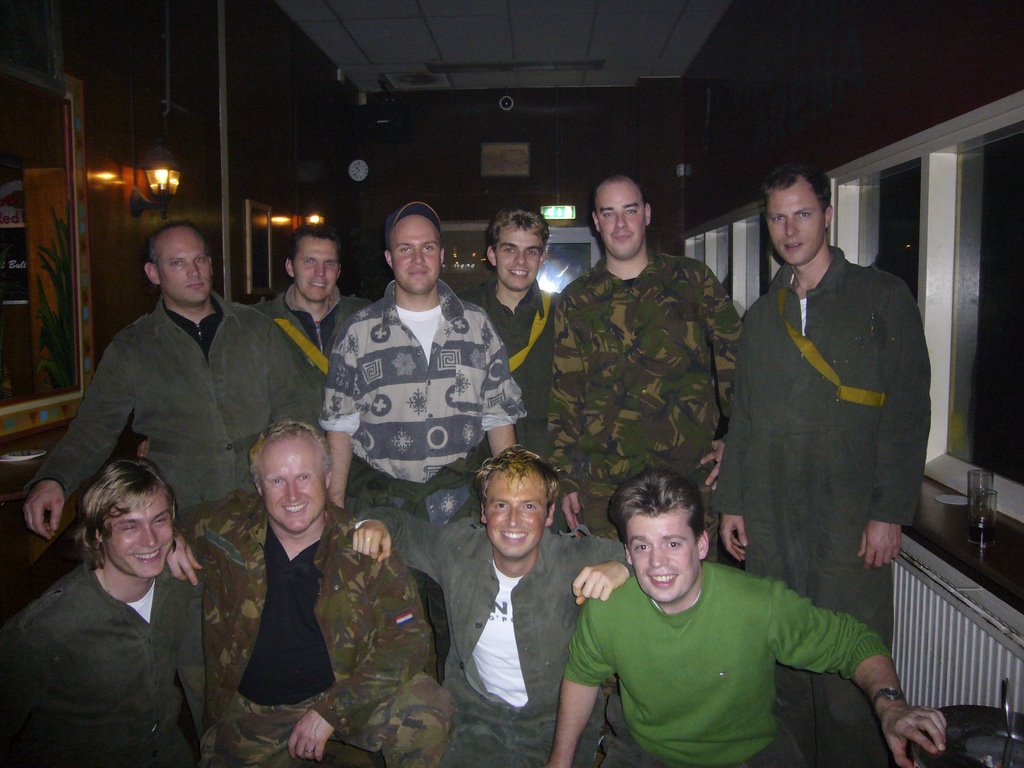
Okay, now let's start with a list of five things about our CPM-practitioners most people don't know (or don't want to know ha ha ha). You can use this photo to obtain a visual of the cpm-practitioner or just have a look at his blogger profile.

  1. Let's first start with myself. Before I joined Deloitte I was in the Graduate Programe Economics & Finance at the Universitat Pompeu Fabra. As you all know, studying cost a lot of money so I needed a job on the side! I applied for a job at the Baja Beach Club. What can I say about it? Just check the link and you will find out why it's so hilarious. In the picture mentioned before I am the guy to the left on the lower row.
  2. Let's move on to Bart van Onzen. Funny thing about Bart is he likes R&B clubs, however he doesn't like the R&B music itself. So it's for each of you to decide what he likes. It has something to do with girls (sorry Bart). Bart is the fourth guy from the left at the upper row.
  3. Rutger van den Berg has a couple of funny things, however, I will not mention all of them. Some things are not really professional (or I am wrong Rutger ha ha ha). When Rutger was a student he wore a mullet (long hair till his shoulders - Business upfront, Party in the Back!). Before Rutger was a student he worked for the Secret Service (back then he was just fifteen). He retired from active duty at the age of twenty. The reason he retired was his addiction to chocolate, which can be a pain in the ass during a stake-out! Rutger is the first guy from the right at the upper row.
  4. Now we are talking about addictions, it's time to introduce Damien Wiegman. Damien always looks like he just came back from holiday. Completely (well, completely I don't know actually!) tanned and always ready for a party. The tanning center is really happy to have him as a customer. Damien addiction is for sure the tanning studio. Damien is the second guy from the left at the lower row. As you can see on the picture he took a head-shot during the paintball session.
  5. Last but not least is Edwin van den Broek. I know Edwin from the time I just started at Deloitte. At that time he was driving an small car (Opel Corsa), he was working at big project at Delta Nuts (a energy company in Middelburg) and living in Utrecht. He was renovating his house so he decided to drive back and forward each day. At night time he was renovating his house and with a few hours sleep he went back to Middelburg. So Edwin was driving a little bit less than 400 km each day. You can check out his route description at Google Maps. Edwin is the guy to the left at the lower row.

So enough funny details about our CPM-practitioners. Now it's my time to tag some bloggers.

  1. Ron Tolido
  2. Dan Bricklin
  3. Martin Kloos (dutch only)
  4. Big Four Alumni
  5. Roberdan

Okay guys: TAG! You're it now...

Friday, December 22, 2006

14th International XBRL Conference – Philadelphia, PA

Nearly 500 attendees from diverse segments of the business, government, and academic communities met in Philadelphia last week for the 14th International XBRL Conference, evidence of the positive momentum and great interest in XBRL among regulators, accounting standard setters, analysts and the public and private sectors across the globe. The city of Philadelphia set an appropriate backdrop for a theme of revolutionary times, relevant today to the XBRL phenomenon and its potential global impact on capital markets, financial and business reporting, and business transformation.

Deloitte is playing an active and increasing role in XBRL on a global scale because of its importance to our clients and the potential effect that it will have on the external audit and other services that we provide. We were a platinum sponsor of the Philadelphia conference with significant presence, including presentations from leadership, technical training, and Deloitte representation from North America, Europe, and Australia.

Key Speakers
Bob Kueppers, Deputy CEO, Deloitte USA LLP, joined a host of financial industry luminaries to address the plenary session, including leaders of the International Accounting Standards Board (IASB), International Federation of Accountants (IAFC), Bank of Spain and, from the United States: the SEC, FDIC, FASB, FAF, and the AICPA. Bob believes that XBRL can play a key role in helping companies meet the challenges of managing their businesses and evolving reporting and regulatory requirements. “(XBRL) facilitates reporting information for multiple purposes, which is critical in the current environment of multi-GAAP reporting, overlapping regulatory requirements and dynamic internal reporting needs. It provides the platform for truly integrated reporting, bringing financial, risk and control, and operational information together.”

Bob spoke about the impact of XBRL on the profession. “We need to make sure we understand and are prepared for the potential effect of XBRL in conducting audits, by asking ourselves: What will we be auditing in the future? (We know we will be providing assurance on financial statements filed in XBRL – what about other business information?) How will we execute our audits in an XBRL reporting environment? How can the ability to transfer XBRL data without manual re-entry be used to improve the audit trail? How can the power and flexibility of XBRL be used to develop better audit tools? In the future, will auditors be auditing the financial statements OR will we be auditing the process by which statements are prepared?”

Bob also called for the profession and all stakeholders to “take the lead in driving XBRL forward, playing an active role in shaping the future of business reporting, and dramatically shorten the time that it takes for investors, regulators, public companies and the accounting profession to reap the benefits of these powerful new ideas. “

A transcript of Bob’s speech can be found at:
https://www.deloitteresources.com/pgContent.aspx?cid=240053

SEC Chairman Christopher Cox was the keynote speaker at the conference. The SEC has been redoubling efforts to get U.S. companies to use XBRL in financial statements. Chairman Cox reiterated that the SEC is working to accelerate the development of U.S. GAAP taxonomies and is committed to their completion by mid-2007. This major undertaking, in which Deloitte is becoming involved, will result in a fully functional U.S. GAAP taxonomy that will support financial statement filings by this time next year.

Reconciling differences between U.S. and international accounting standards is another area where Cox expects interactive data to be helpful. “It's easy to imagine more that the world can do with this powerful new capability… It is already possible to imagine that XBRL taxonomies — written without bias toward any particular set of accounting rules — could be used to instantly translate any given set of financial data from one accounting system to another.”

Chairman Cox also commented on the effects of XBRL on our profession. “I want to commend the XBRL International Assurance Working Group, which met at the World Congress of Accountants in Istanbul last month, and will meet again here on Thursday. The Working Group is absolutely right to consider how the adoption of XBRL might improve the audit process. Just last month, in a report issued at the Global Public Policy Symposium in Paris, six of the world's top accounting firms extolled the benefits of XBRL, and firmly stated their belief that its adoption will significantly lower both internal and external audit costs.” (This report can be found at:
http://www.xbrl.org/Announcements/Interactive-Data-Assurance-2006-11-10.pdf)
A full transcript of Chairman Cox’s speech can be found at
http://www.sec.gov/news/speech/2006/spch120506cc.htm

The Deloitte Exhibit
At the Deloitte conference booth we provided practical demonstrations to showcase the technology we’re already using around XBRL. Two tools were featured. The Deloitte Radar (DDAR) pilot tool which benchmarks financial information using XBRL data, and begins to bring the idea of XBRL as an integral part of the audit approach. One of our member firms, Deloitte Australia, is developing and presented a tool to support an online service that will be made available to small and medium sized companies in Australia. Through this tool, companies provide their financial data that is then converted to XBRL to meet a variety of external filing requirements or for internal consolidation.

XBRL Technical Training
Yossef Newman, Deloitte Project Manager for XBRL and Jeff Hansen, AERS, delivered a full day technical training program, "Preparing XBRL Financial Reports". This XBRL International certified course introduced participants to basic XBRL concepts and common XBRL report editing tools, and included hands on exercises in the preparation of XBRL based financial reports.

For more information regarding the 14th International XBRL Conference, please visit the website at
http://conference.xbrl.org/ The 15th International XBRL Conference is scheduled to be held in Munich, Germany in June 2007.

Deloitte’s leadership role in this important gathering is noteworthy, and consistent with the position we are taking, both in the U.S. and globally, in the XBRL initiative. Though we can’t be sure of the pace of its adoption, the conference underscored for me the fact that we are at a critical point in time where we must recognize the importance of XBRL to our business. The impact that it might have on reshaping our business models for auditing and the services that we provide to both attest and non-attest clients requires a rapid response and increasing involvement on our part. When we also consider the demands that are potentially at hand from the regulators, and the needs of our clients who are pursuing various uses of XBRL, our mandate for action becomes clear.

Wednesday, November 22, 2006

CPM in the Financial Services Industry

Last week I attended the Deloitte FSI Practitioners Day, a meeting of Deloitte professionals working in the Financial Services Industry. I was invited to make a presentation on the relevance of CPM for companies in the financial services industry (banking, insurance, hedge funds, pension funds etc.). I posed the statement that CPM in today’s business environment is mission-critical for the financial services industry. A number of observations led me to this conclusion.

First of all, despite the number of challenges facing the industry, opportunities for growth are plentiful – particularly through expansion in new markets, technology and personalization to enhance customer relationships and new products and advisory services to meet the needs of retiring baby-boomers.

To grow, the financial services industry needs to address a number of issues. First, spurred by falling cross-border investment barriers, financial services companies will expand abroad by acquiring or merging with companies in other countries. Banks are moving away from traditional outsourcing toward captive operations or a mix of captive and outsourced functions. China will be a critical market, but presents geopolitical risks and structural market challenges. Second, slow growth in existing markets will push financial services companies to reconnect with customers through a combination of state-of-the-art technology and personal service. Third, in an increasingly strict regulatory environment, financial services companies must adopt a principles-driven approach to policies, standards and systems to ensure compliance. Fourth, financial services companies now view operational and reputational risk to be greater concerns than market, credit and liquidity risk. Data privacy and security have become hot issues and will remain so for the foreseeable future. Fifth, an aging population will continue to drive the development of financial products and services targeted to older customers.

To survive in this dynamic, turbulent and competitive environment, companies in the financial services industry need to create a sustainable competitive advantage. This requires the right size. Size offers a way to capture economies of scale and deliver products more efficiently. US banking consolidation may have largely run its course, but Europe’s has barely begun, and the potential for cross-border consolidation has risen dramatically. Second, service matters – and technology offers a cost-efficient way to offer customers more convenience, value and the “mass personalization” necessary to build loyalty. Third, to improve compliance quality while holding down costs, financial services companies must be able to combine a top-down principles-based approach with enough flexibility to adapt to local regulations. Related to the compliance issue is the need to guard against operational glitches that could damage the bank’s reputation. Finally, financial services companies are facing an imperative to develop specialized products and advisory services aimed at an older population.

In short, to be succesful, financial services companies need to have a clear strategic focus based on challenging growth objectives, cost reduction initiatives, operational excellence, and customer centricity.

The CFO will play an important role in developing and executing this strategy. The traditional roles of the CFO are to balance capabilities, costs and service levels to fulfill the finance organisation’s responsibilities, and to protect and preserve the assets of the organisation. CFO’s today however, feel more pressure than ever to provide financial leadership in determining strategic business direction and align financial strategies, and to stimulate behaviors across the organisation to achieve strategic and financial objectives.

One of the key ways for the CFO to play his role as a strategist and catalyst is corporate performance management. By improving the connection between strategic initiatives and business plans, and by enhancing the planning process to increase collaboration in budgeting and forecasting, CFO’s provide strategic leadership. They act as catalysts of organizational change by promoting predictive analysis instead of backward looking, and by creating an integrated performance scorecarding and reporting process. It’s because of this contribution to the CFO’s role as strategist and catalyst, that CPM is becoming mission-critical for the financial services industry.

Monday, November 13, 2006

The Future Of Company Reporting Looks Bright!

Last week at the Global Public Policy Symposium in Paris, the CEOs from the largest professional services firms presented a united vision proposal for the profession and the future of financial reporting.

The paper was developed in an effort to focus discussion on issues that directly affect the services provided by professional services firms. The symposium participants included the senior leadership from BDO International, Deloitte, Ernst & Young, Grant Thornton, KPMG, and PricewaterhouseCoopers, as well as an array of regulatory officials and investors from around the world.


As you might imagine, the vision paper and symposium attracted heavy media coverage. The CEOs signed an op-ed piece about their shared vision that appeared in the Wall Street Journal. All CEOs participated in media interviews for CNN International business, the Wall Street Journal, and the Financial Times. By working together, the CEOs are helping to shape public opinion about issues that will map the future of company reporting.

I think this is good news if you take Corporate Performance Management seriously. Why? Well first of all, because this will help to improve the quality and usefulness of company reporting. Thanks to Internet and digitization, information will become more of a commodity product, that stakeholders can customize and consume the way they want it. For example, some investors may want to know about the earnings, cash flows, and perhaps other variables for a company currently and over some past period. Others may want each of these variables compared to other companies in the same industry or a similar “peer group”, or compared to averages for the market as a whole (or some portion thereof).

Second, it is directed at improving the frequency of company reporting. Why, in a world where most public companies’ financial records are, or soon will be, in digitized form, should investors and other parties have to wait a full quarter to receive pertinent financial information? Technology allows far more frequent reporting, even daily, although with different levels of assurance about its accuracy than for financial statements that are subject to regular audits.

Last but not least, this vision is aimed at providing more qualitative and non-financial information that helps stakeholders to understand how businesses perform in the future. Yet financial statements are backward looking documents. They tell how a company has performed in some recent period. Perhaps some of the information contained in the financials is indicative of future performance, but much of it is not.

Instead, non-financial measures like innovative success, customer satisfaction, product or service defects or awards, and employee satisfaction would provide powerful incentives to corporate executives to manage their companies in ways that benefit not only their shareholders, but their employees, customers and the wider economies in which they conduct business. In particular, companies that look likely to prosper but in fact may be in trouble would have stronger incentives to take corrective action sooner than otherwise. Conversely, companies whose prospects are really brighter than current financial data may indicate may not be penalized by investors, and thus find it easier to borrow funds for expansion, to retain or expand their customer base, and to retain or recruit new employees.

In short, the new reporting model should be more useful to stakeholders, more frequent, and help in predicting future company performance. It will impact the way executives manage their businesses, lead to a convergence of internal management information and external reporting, and will leverage existing CPM systems and developing technologies like XBRL.

If the leaders of the big international audit networks succeed in bringing their vision to life, this might very well be the next wave after compliance and IFRS. And this time, it appears to be one that will really benefit both internal and external information producers and consumers. And I think that’s really good news!

Sunday, November 05, 2006

CPM: mission critical for your organization?


From 1 until 3 November Cannes (France) was the venue of the Outlooksoft European User Forum 2006. Within the sunny and beautiful surroundings of the Cote d' Azur there were numerous opportunities to meet Outlooksoft customers, Outlooksoft partners and Outlooksoft employees. Central theme during the conference was the presentation of Outlooksoft’s latest product: Outlooksoft 5 .

Outlooksoft 5 promises to offer ever increasing powerful CPM solutions based on continuous technological innovations and active incorporation of customer feedback. Unique focus is given on the planning and the predictive analytics that Outlooksoft 5 offers to its clients. Or as Outlooksoft CEO Phil Wilmington formulates it: “The ability to be a predictable enterprise in today’s market is mission critical.”

But what does this mean mission critical? A company’s mission states why the company exists (raison d’ĂȘtre) and what it wants to achieve on the short to mid term. Hence, a mission has something to do with a company’s strategy and its performance. So CPM is critical for the performance of organizations? Let’s find out!

In today’s global, turbulent and dynamic marketplace more and more flexibility and transparency is asked of organizations. Shareholders want to receive maximal value for their investments. Governments and legal bodies ask for increasing accountability of past and present results. Market barriers decline resulting in increasing competition. Customers expect ever more value for their money.
To cope with the increasing complexity of the marketplace managers feel the need for timely and relevant information which enables them to make the right decision on the right time. Achieving a sustainable competitive advantage demands insight and forward visibility to the business.

With the integration of financial and operational information, compliance orientated features, workflow controls, predictive analysis capabilities and the integration of Business Process Flow (BPF) technology CPM solutions are more and more meeting the demands of the competitive marketplace. CPM should not only address retrospective financial accountability and compliance. The capability to transform financial, operational and strategic information into reliable and timely predictive analysis will revolutionize the way organizations compete.

Successful CPM implementations align and streamline processes and systems starting with the company’s strategy. Goal of the implementation should be to offer a tailored and unique solution meeting the demands of the local marketplace and the company’s ambitions. Investing in the necessary systems and CPM tools is therefore just one part of the implementation. More important is how you organize and translate your information needs across the processes and systems. Hence, a successful CPM implementation does not just mean joining the bandwagon.
Unique solutions will offer organizations the opportunities for achieving sustainable competitive advantage. When implemented successfully CPM can help companies achieve goals, quantify success, effectively allocate resources, chart the continuing course and give accurate predictions for future investments. CPM can offer the critical information to outperform your competitors.

Is CPM mission critical for your organization? I reckon it is!

Corporate Performance Management Conference: TakeAways

Last thursday we attended the Annual Corporate Performance Management Conference which was held last in Noordwijkerhout last thursday. After arriving fashionably late and a rebuke of the organisation (thanks Danja!) the congres turned out to be a great succes. Our Deloitte stand had a big part in this succes.

A few takeaways sticked in our memory which we would gladly share with you.

  • At Trespa they keep their managers eager by displaying, every day, a KPI dashboard which directly relates to their bonus. And if the dashboard is offline for a second the managers start complaining (even in the weekends)!
  • Why do you need 98 KPI's to manage a company while you can fly a Boeing by just ten indicators? However you will need correct data to support your KPI's! Did you ever fly with a Boeing with an altimeter (altitude indicator) saying 3000 feet while you were flying 30 feets above the grounds? Arnold Pureveen (De Alliantie) likes to call it the Duck Theory (whatever that may mean). We like to say: "Just KISS" (KISS: Keep It Simple and Sound).
  • 'Just do it' is not only known as Nike's motto it is also the corporate CPM phylosophy of Arcelor Mittal. When they take-over new companies they just say: ''deliver the necessary information; incompleteness and incorrectness is of later concern''. This makes it possible for Mittal to fully integrate new companies in their Planning & Control cycle within a month. This effective strategy only works for large companies where small companies have no material impact.
  • Child Care is a hot issue in the dutch society. A few years ago it was more or less like a 'soft' sector in Holland. Nowadays big controllers and financial directors are switching to this sector to give it the necessary professionalism. A great example is Wim Westerink from SKON. First the financial man at Mexx Europe, now one of the leading persons behind one of the biggest (within a few months the biggest if we may believe Wim Westerink) child care organisation in the Netherlands.
  • The winner of the CPM Award 2006 is Tjero Zomer (CFO at Transavia.com). Performance Management is one of the main foundations of the operational management at Transavia. This year Transavia closed their books (including IFRS adjustments) within five days. This is a textbook example of what we call at Deloitte 'A Fast Close' and a perfect benchmark for other companies in the sector.
  • Due to a fever Dennis van der Geest was unable to attend. Cor, his father replaced him. Cor has been very succesful as a coach for different judokas. He gave the audience his point of view on 'how to manage performance'. He illustrated this by lively examples and made clear that to be successful you need a leader that can inspire.

Monday, October 30, 2006

How to implement CPM projects succesfully?

The Standish Group reported in 1994 (the Chaos-report) that a third of all ICT-related implementations failed or were cancelled. Recent research (Ernst & Young) shows that six out of ten ICT-related projects go wrong, despite the fact that organizations have learned to work thematically and Prince2 has been generally accepted as the project management methodology.

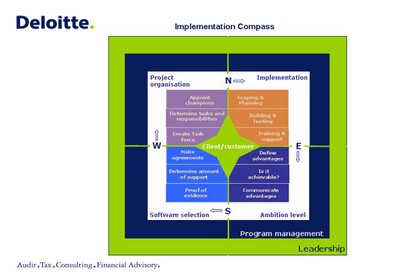
That many CPM-implementation projects do not deliver on time, within approved budget and expected quality is no surprise to me, what is more surprinsingly is the fact that the problem is seen as a managerial problem (Prince2). I believe that the main problem is caused by a lack of understanding of the impact and preconditions of any kind of ICT-implementation project. The characteristics of any ICT-implementation project is that they are once-only, commitment sensitive and that they have a major impact on the way 'things are done'. In our CPM practice we do not soley trust on Prince2; we also believe that for a successful implementation the client has to go through different stages of what we call the 'Implementation Compass’.

The Implementation Compass is based on the following four parts: the house, the clockwork, the clockface and the direction indicator. Leadership is 'the house' for every implementation project. It is the basis for present and future success. Leadership has to be present in every stage of the implementation project. Without leadership the project will surely fail. Program management is the clockwork. It connects the house (leadership) with the clock face (the position within the implementation project). The clock face dictates the position within the implementation project. It gives the steps that have to be taken. The direction indicator shows which activities per stage have to be undertaken by the client. A short summay of the Implementation Compass is given below.

Leadership is not the same as project or program management. Leadership exists out of a number of steps that are necessary to realize change succesfully. Leadership defines how the future looks like, aligns people with that vision and inspires people to achieve that vision despite the obstacles.

To align Leadership with the four stages of an implementation project, program management can be necessary when the implementation project is strategic or when the change is extensive or has to be achieved under time pressure.

Ambition level (from East to South). The business case has to give a clear answer on what the advantages are, not only measured in financial terms but also in qualitative tems. It should also state the vision on CPM over the next 3 - 5 years. The next step is to test the whole business case on achievability (a sanity check) per year and phase. The last step is communication. Always make sure that everyone involved directly and indirectly is informed on the advantages and expectations (explain the Why and What).

Software selection (from South to West). In this stage it is necessary to measure what the track record is of the suppliers on the short list. How proven is their technology and what is the response time and qualtity of support? And finally always make sure to make profound legal contracts with supplier and internal ICT-department. In these contracts make clear what the tasks, responsibilities and authorizations are for all involved parties. Make also sure what the consequences financially are for all parties involved in the situation of no compliance to the agreement.

Project Organisation (from West to North). The project organisation has to achieve the intended advantages of the business case. The client has to create a task force kind of project team, for every role determine the tasks and responsibilities and appoint champions with enough reputation to get things done.

Implementation (from North to East). Implementation knows the following standard phases. Scope, planning and functional and technical design, building and testing, training and support go-live. During the implementation, configuration of the application management organisation is an aspect that needs special attention. The specific point where you put the "border" between the system-related responsibilities of accounting and those of IT is to a large extent arbitrary and can therefore vary from one implementation to the next, but the key criteria we use are:
1. The faster the response required, the more the support needs to sit with accounting.
2. The more technical the type of issue, the more it needs to sit with IT.

For all stages within the Implementation Compass we have developed multiple check lists that are easy use. We use it as an evaluation tool for CPM implementations, but also as a tool to guide the client through this difficult change process.

Author: Edwin van den Broek (edvandenbroek@deloitte.nl)

Tuesday, October 24, 2006

What does the P in CPM really stand for?

At the start of any CPM initiative, the future tends to look bright for everybody involved. There is great vision and leadership, major benefits to be achieved, and the best possible software to support the initiative.

After a few months however, the initial enthusiasm usually begins to decrease. Senior executives have new issues to worry about, project team members are swamped with everyday routines, and the software appears to be unable to fulfil all requirements. The project that was so well managed in the beginning is now merely muddling through. New requirements are creeping into scope, the software is being tweaked to the max and beyond, and the original strong vision seems to be long forgotten.

But a few project trips, some executive pep talk, several stiff conversations, and a lot of hard work later, the project is finally ready to 'go live'. All is well that ends well! Or is it? Finance staff now seems to be having a lot of issues getting their data into the new system. Remote locations can't even connect. Producing reports is taking longer then ever before. The system keeps crashing for no apparent reason. It is slowly becoming clear what the P in CPM really stands for...managing the performance of the CPM system.

The first step is usually to perform some stress and performance testing, remove a few obvious bottlenecks and simpy upgrade the hardware. Most of the times this is not enough. As the systems grows over time, new performance issues arise that prove even more difficult to resolve. Improving performance is a war that has to be fought on several frontlines at the same time. More than a state-of-the-art IT infrastructure, it involves hard decisions on the architecture of the whole CPM system, trading off functionality with performance, changes to the process and organization underlying the CPM system, and, yes, some more stiff conversations.

In hindsight it is always easy to explain the poor performance. It usually comes down to taking more time to think things through at the start. Are all the must-have requirements really that critical? What else do we want from the system after the initial implementation? What is the simplest way to start? Why don’t we say goodbye to some of the dysfunctional practices that have developed over the years? These are not easy questions to answer. But answering them is critical to the ultimate success of the CPM initiative.

To end this blog on a positive note: there are a lot of experienced people out there that can help you in answering these questions, and making your CPM future look brighter.